
News & Events
Job-Ready Revit Course: What Makes a BIM Course Truly Effective?
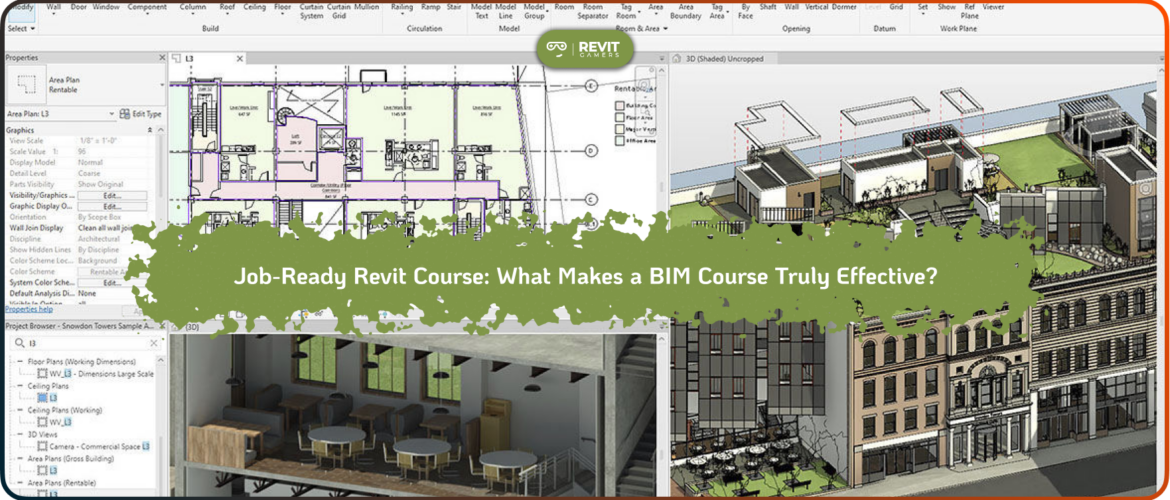
In the BIM and Revit education space, the term “job-ready” is used everywhere. Almost every platform claims to offer a job ready revit course, but in reality, only a small percentage of learners actually become employable after completing them. This raises an important question: what does “job-ready” actually mean in 2027?
For most beginners, job-ready simply means knowing how to use Revit tools. If they can model walls, create floors, or produce drawings, they assume they are ready for employment. However, the BIM industry does not define readiness this way. Companies are not looking for software users—they are looking for professionals who can operate inside real project environments.
In practice, being job-ready means understanding how BIM projects actually work. It includes workflow knowledge, documentation standards, coordination processes, and the ability to contribute to a team-based production environment. Without these skills, even technically strong users struggle to get hired.
This is where the gap begins. Many learners complete a job ready revit course, feel confident in their skills, but still fail in interviews or job applications. The reason is not lack of effort—it is mismatch between training content and industry expectations.
This article breaks down what actually makes a Revit course truly job-ready. Instead of focusing on marketing claims, we will analyze the real skills employers expect and how effective training systems are structured to produce employable BIM professionals.
Learn more: Revit Classes Comparison: In-Person vs Online with Visuals
Revit Gamers is offering
The most efficient
& market's only animated Revit training
Learn More
The Myth: Learning Revit = Getting a Job
One of the biggest misconceptions in BIM education is the belief that learning Revit automatically leads to employment. This assumption is the main reason many learners feel frustrated after completing a job ready revit course but still struggle to find work.
In reality, Revit is just a tool. It is similar to learning software like AutoCAD or Excel—useful, but not sufficient on its own. Employers are not hiring people because they know buttons and commands. They are hiring individuals who can contribute to real project delivery.
Many beginners focus heavily on software features. They spend hours learning modeling techniques, family creation, and rendering tools. While these skills are important, they only represent a small portion of what is required in a professional BIM environment.
Real projects involve much more than modeling. They require coordination between disciplines, structured documentation, file management, and adherence to project standards. Without understanding this broader context, even skilled users struggle to perform in real job scenarios.
This is why so many people complete a job ready revit course and still say they cannot get hired. The issue is not technical ability—it is lack of alignment with real-world expectations.
Understanding this myth is the first step toward becoming truly job-ready.
What Employers Actually Expect from BIM Candidates
To understand what makes a job ready revit course effective, it is important to first understand what employers actually want. In most BIM-related roles, hiring decisions are not based solely on technical knowledge.
Employers expect candidates to understand workflows. This means knowing how a project moves from concept to documentation and how different stages are connected. A BIM professional must understand not just how to model elements, but how those elements fit into the entire project structure.
Documentation skills are also critical. Companies expect clean, organized, and standardized outputs. This includes properly structured views, sheets, annotations, and schedules. A disorganized model is often considered a sign of poor professional readiness.
Another important expectation is collaboration. BIM projects are team-based environments involving architects, engineers, and contractors. Candidates must understand how to work within shared models, communicate effectively, and follow coordination standards.
Finally, employers look for adaptability. Projects change constantly, and professionals must be able to adjust quickly without breaking workflows.
These expectations highlight a clear truth: a job ready revit course must teach more than software—it must teach professional behavior inside BIM environments.
Learn more: change units in Revit: How to Change Project Units for International Projects
Core Pillar #1: Real BIM Workflow Training
A truly effective job ready revit course must be built around real BIM workflows. Without workflow understanding, software knowledge remains incomplete and non-transferable to real jobs.
A BIM workflow is a structured process that includes project setup, modeling, documentation, coordination, and final delivery. Each stage depends on the previous one, forming a continuous system rather than isolated tasks.
Many courses fail because they teach Revit as separate features. Learners learn modeling in one lesson, documentation in another, and families in another—but never understand how these elements work together in a real project.
In professional environments, everything is connected. A change in a model affects documentation. A coordination issue affects design decisions. A workflow-based approach teaches learners to think in systems rather than isolated tools.
This is what separates job-ready candidates from beginners. When learners understand workflows, they can adapt to real project demands much more effectively.
Structured platforms like RevitGamers are built around this principle, focusing on complete BIM workflows rather than fragmented tutorials. This helps learners develop a more realistic understanding of how Revit is used in actual industry environments.
Core Pillar #2: Project-Based Learning (Not Tutorials)
Another essential element of a job ready revit course is project-based learning. Watching tutorials is not enough to prepare for real BIM work.
Tutorials often show step-by-step instructions, but real projects do not come with instructions. In a real job, professionals are expected to solve problems, make decisions, and deliver complete outputs independently.
Project-based learning simulates this environment. Instead of learning tools in isolation, learners work through complete BIM scenarios. This includes modeling structures, organizing documentation, and managing project workflows from start to finish.
This approach builds critical thinking and decision-making skills. It also helps learners understand how different parts of a project are connected.
Without project experience, learners often struggle when faced with real-world tasks, even if they have watched hundreds of tutorials.
A proper job ready revit course must therefore focus heavily on full project execution rather than isolated exercises.
Learn more: Reset Revit UI: Bring Back Your Lost Panels Easily
Core Pillar #3: Portfolio That Matches Industry Standards
A strong portfolio is one of the most important outcomes of any job ready revit course. Employers rely heavily on portfolios to evaluate real capability.
A job-ready portfolio is not just a collection of images. It must demonstrate complete project understanding. This includes structured models, proper documentation, and clear presentation of workflows.
Many beginners make the mistake of including disconnected exercises. While these may show technical ability, they do not demonstrate professional readiness.
A strong portfolio tells a story of how a project was developed from start to finish. It reflects organization, consistency, and understanding of BIM processes.
Structured learning systems naturally produce better portfolios because they guide learners through complete projects instead of random tasks. Platforms like RevitGamers emphasize this approach, helping learners build portfolios that reflect real industry expectations rather than tutorial-based outputs.
Learn more:: How to Fix Revit File Corruption: Step-by-Step
Revit Gamers is offering
The most efficient
& market's only animated Revit training
Learn More
Core Pillar #4: Coordination & BIM Collaboration Skills
Modern BIM work is collaborative. A job ready revit course must therefore include coordination and teamwork skills.
In real projects, architectural, structural, and MEP models must align correctly. Errors must be identified and resolved before construction begins.
This requires communication, coordination awareness, and understanding of multi-discipline workflows. Many courses ignore this entirely, which creates a gap between training and real job requirements.
Without collaboration skills, even technically strong users struggle in professional environments.
Core Pillar #5: Interview & Job Simulation Preparation
Being job-ready also means being able to pass interviews and technical tests. A strong job ready revit course must prepare learners for these real hiring scenarios.
This includes explaining workflows clearly, presenting portfolios confidently, and completing practical tasks under time pressure.
Many candidates fail not due to lack of skill, but due to inability to communicate their knowledge effectively.
Why Most Revit Courses Fail to Produce Job-Ready Students
Most courses fail because they focus too much on tools and too little on workflows. They teach Revit features but do not simulate real BIM environments.
As a result, learners finish courses with knowledge but without employability.
This is why many people complete a job ready revit course but still struggle to enter the job market.
What a Truly Job-Ready Revit Course Must Include
A true job ready revit course must include structured progression, real BIM workflows, project-based learning, portfolio development, coordination training, and interview preparation.
Without these elements, a course remains educational—but not job-ready.
Structured systems like RevitGamers focus on combining these components into a single learning path, helping learners transition from software users to BIM professionals.
The real measure of a job-ready course is not what it teaches—but what it enables you to achieve in the real world.
Revit Gamers is offering
The most efficient
& market's only animated Revit training
Learn More
Leave a Reply
You must be logged in to post a comment.