
News & Events
Best Online Revit Course: How to Choose the Right One in 2027
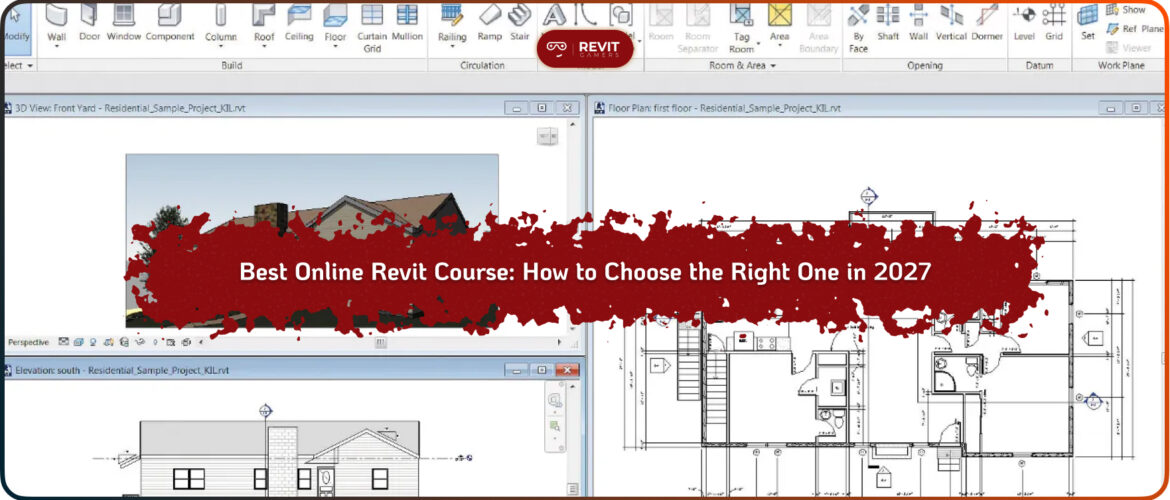
In 2027, learning Revit has become more accessible than ever, but at the same time, choosing the Best Online Revit Course has become significantly more difficult. The number of platforms, instructors, and learning styles has exploded, making it confusing for beginners and even intermediate users to decide where to start. Some courses focus heavily on theory, others rush through tools, and only a few provide a balanced, structured learning experience that truly prepares learners for real-world BIM work.
Revit is no longer just a software skill—it is a core requirement in architecture, engineering, and construction industries. Employers expect professionals not only to know the tools but to understand workflows, project coordination, and real project execution. Because of this, selecting the right course can directly impact your career speed and success. A poorly chosen course can lead to wasted time, incomplete understanding, and frustration, while a well-designed program can accelerate your progress dramatically.
The challenge is not access to information, but filtering quality. Everyone promises to be the Best Online Revit Course, but very few actually deliver structured learning, real projects, and industry-relevant skills. In this article, we will break down exactly what makes a course valuable in 2027, how to evaluate different options, and what key factors you should consider before investing your time or money. By the end, you’ll have a clear framework to confidently choose the right Revit learning path for your goals.
Learn more: Revit Classes Comparison: In-Person vs Online with Visuals
Revit Gamers is offering
The most efficient
& market's only animated Revit training
Learn More
Why Choosing the Right Revit Course Matters
Choosing the right Best Online Revit Course is not just about learning software—it directly affects how fast and how effectively you become job-ready. Revit is a complex BIM tool that requires structured understanding, not random exposure to features. If you start with the wrong course, you may develop gaps in your knowledge that become difficult to fix later.
Many learners underestimate the importance of course quality and assume that all Revit tutorials are the same. In reality, the difference between a structured, project-based course and a basic video playlist is massive. A good course teaches workflow thinking, not just button-clicking. This means you learn how different tools interact in real projects, how professionals structure files, and how BIM coordination actually works in practice.
Another important factor is time efficiency. A well-designed Best Online Revit Course helps you avoid unnecessary content and focuses only on what matters for real-world application. Instead of spending months figuring things out alone, you follow a guided path that leads to measurable progress. Poor course selection often results in repetition, confusion, and loss of motivation.
Career impact is another major reason this decision matters. Employers and clients expect practical skills, not just theoretical knowledge. A strong course builds your portfolio through real projects, which significantly improves your chances of getting hired or winning freelance work. In contrast, weak courses often leave learners with knowledge but no practical output.
Ultimately, choosing the right course is an investment in your future efficiency, confidence, and career growth.
What Makes a Best Online Revit Course?
A truly Best Online Revit Course is defined not by marketing claims, but by structure, depth, and practical application. The most important characteristic is a clear learning path. Instead of jumping between unrelated topics, the course should guide learners from basic concepts like interface navigation and simple modeling to advanced workflows such as collaboration and project management.
Another key factor is project-based learning. Revit cannot be mastered through theory alone. A high-quality course integrates real-world projects that simulate architectural or engineering tasks. This helps learners understand not just how tools work, but when and why to use them.
Depth of explanation is equally important. Many courses focus only on surface-level instructions, showing what to click without explaining the logic behind it. A strong Best Online Revit Course goes deeper, helping learners understand BIM principles, workflow decisions, and industry standards. This builds problem-solving ability rather than memorization.
Consistency in teaching style also matters. A well-structured course maintains a unified approach throughout all lessons, reducing confusion and improving retention. Learners should feel that each module connects logically to the next.
Some modern platforms have started focusing heavily on this type of structured learning. For example, platforms like Revit Gamers emphasize detailed workflows, step-by-step projects, and practical understanding rather than rushed tutorials. This type of approach reflects what a modern high-quality Revit learning experience should look like in 2027.
A great course ultimately transforms beginners into confident users who can handle real BIM tasks independently.
Learn more: Reset Revit UI: Bring Back Your Lost Panels Easily
Free vs Paid Revit Courses
One of the biggest decisions learners face when choosing the Best Online Revit Course is whether to go for free or paid options. Both have advantages, but they serve very different purposes. Free courses are widely available and can be helpful for getting a basic understanding of Revit. They are ideal for exploring the interface, learning simple tools, and deciding whether you want to commit to BIM as a career path.
However, free courses often lack structure. Content is usually fragmented, meaning learners have to piece together information from multiple sources. This can lead to confusion, missing fundamentals, and inconsistent learning progress. Free content rarely includes complete project workflows, which are essential for real-world application.
Paid courses, on the other hand, are designed to provide a complete learning journey. A strong Best Online Revit Course in the paid category typically includes structured modules, real projects, assignments, and sometimes even feedback or mentorship. This creates a much more efficient learning environment.
Another major advantage of paid courses is depth. They go beyond basic tool explanations and focus on how Revit is used in professional workflows. This includes collaboration, documentation standards, and BIM coordination, which are rarely covered in free content.
The key takeaway is that free courses are good for exploration, but paid structured programs are necessary for serious skill development and career preparation.
Beginner-Friendly vs Advanced Courses
Not all learners need the same type of Best Online Revit Course, and choosing the wrong level is one of the most common mistakes. Beginner courses are designed for users with no prior experience. They focus on basic interface navigation, simple modeling tools, and fundamental concepts like levels and grids. These courses are slow-paced and highly structured to ensure proper understanding.
Intermediate courses, however, assume that learners already understand the basics. They focus more on workflows, documentation, and project development. At this stage, users begin working on more complete models and learn how different Revit elements interact within a project environment.
Advanced courses are designed for professionals or highly experienced users. They focus on complex topics such as worksharing, linked models, parametric families, and large-scale project coordination. These courses are often project-heavy and require strong foundational knowledge.
Choosing the correct level is critical. Starting too advanced can lead to frustration, while staying too basic for too long can slow career growth. The best Best Online Revit Course platforms clearly define learning levels to help users choose the right starting point.
A well-structured learning system ensures smooth progression from beginner to advanced without gaps in knowledge.
Learn more: change units in Revit: How to Change Project Units for International Projects
Revit Gamers is offering
The most efficient
& market's only animated Revit training
Learn More
Course Content Checklist
When evaluating a Best Online Revit Course, one of the most important steps is checking its content structure. A high-quality course should include all essential Revit components, not just isolated topics. At the foundation level, it should cover interface navigation, basic modeling tools, and project setup.
As the course progresses, it must include intermediate topics such as families, parameters, annotation, and sheet creation. These are essential for real project documentation. Without them, learners cannot produce professional output.
Advanced modules should include collaboration tools, worksharing, linked files, and BIM coordination workflows. These are critical for real-world industry environments where teamwork is required.
Most importantly, the course must include real projects. A Best Online Revit Course without project-based learning is incomplete because Revit is a practical tool. Projects allow learners to apply knowledge, solve problems, and build portfolios.
Additional valuable elements include exercises, quizzes, and workflow explanations. These reinforce learning and ensure long-term retention.
A complete checklist ensures that learners are not just watching tutorials but actually building professional-level skills.
Learning Experience & Teaching Style
The teaching style of a Best Online Revit Course plays a huge role in how effectively learners absorb information. Some courses rely heavily on passive video watching, where students simply observe without interaction. While this may work for basic understanding, it is not effective for skill development.
A better approach is active learning, where students follow along with real exercises and projects. This ensures that concepts are immediately applied, improving retention and understanding. Structured pacing is also important, as it prevents learners from feeling overwhelmed or rushed.
A strong course also emphasizes clarity. Complex topics should be broken down into simple, understandable steps. The best instructors explain not just how something is done, but why it is done that way in real projects.
Some modern learning platforms have adopted this more effective teaching style. For example, Revit Gamers focuses on structured, project-driven learning with detailed explanations and real-world application. Instead of rushing through tools, it builds deep understanding through step-by-step workflows, which reflects what a high-quality Best Online Revit Course should deliver in 2027.
Why Some Platforms Stand Out (Soft Promotion Section)
In a crowded market of Revit education, only a few platforms truly qualify as offering a Best Online Revit Course experience. The difference is usually not in content availability, but in how that content is structured and delivered. Platforms that stand out typically focus on depth, clarity, and real-world application rather than surface-level tutorials.
These platforms prioritize project-based learning, where students work through realistic BIM scenarios instead of isolated tool demonstrations. This approach helps learners understand how Revit is used in actual architectural and engineering workflows. It also improves problem-solving skills, which are essential in professional environments.
Another key factor is structured progression. Instead of random lessons, high-quality platforms guide learners step by step from beginner concepts to advanced workflows. This ensures that no important topic is skipped and that skills build naturally over time.
Some platforms, such as Revit Gamers, have become known for this type of structured, deep learning approach. Rather than focusing on speed or shortcuts, they emphasize understanding, precision, and real project execution. This reflects what a modern Best Online Revit Course should look like in 2027—practical, structured, and career-focused.
Conclusion
Choosing the Best Online Revit Course is one of the most important decisions for anyone serious about learning BIM. With so many options available in 2027, the key is not finding the cheapest or fastest course, but the one that offers structure, depth, and real-world application.
A strong course helps you move step by step from beginner to professional, ensuring that you develop not just tool knowledge but real project skills. It saves time, reduces confusion, and significantly improves your chances of career success in architecture and construction industries.
If you are serious about mastering Revit, focus on structured, project-based learning paths that build real confidence and professional ability. The right course will not just teach you software—it will prepare you for real-world BIM work.
Revit Gamers is offering
The most efficient
& market's only animated Revit training
Learn More
Leave a Reply
You must be logged in to post a comment.